

Road Safety Equipment for Parking: A Layout Guide
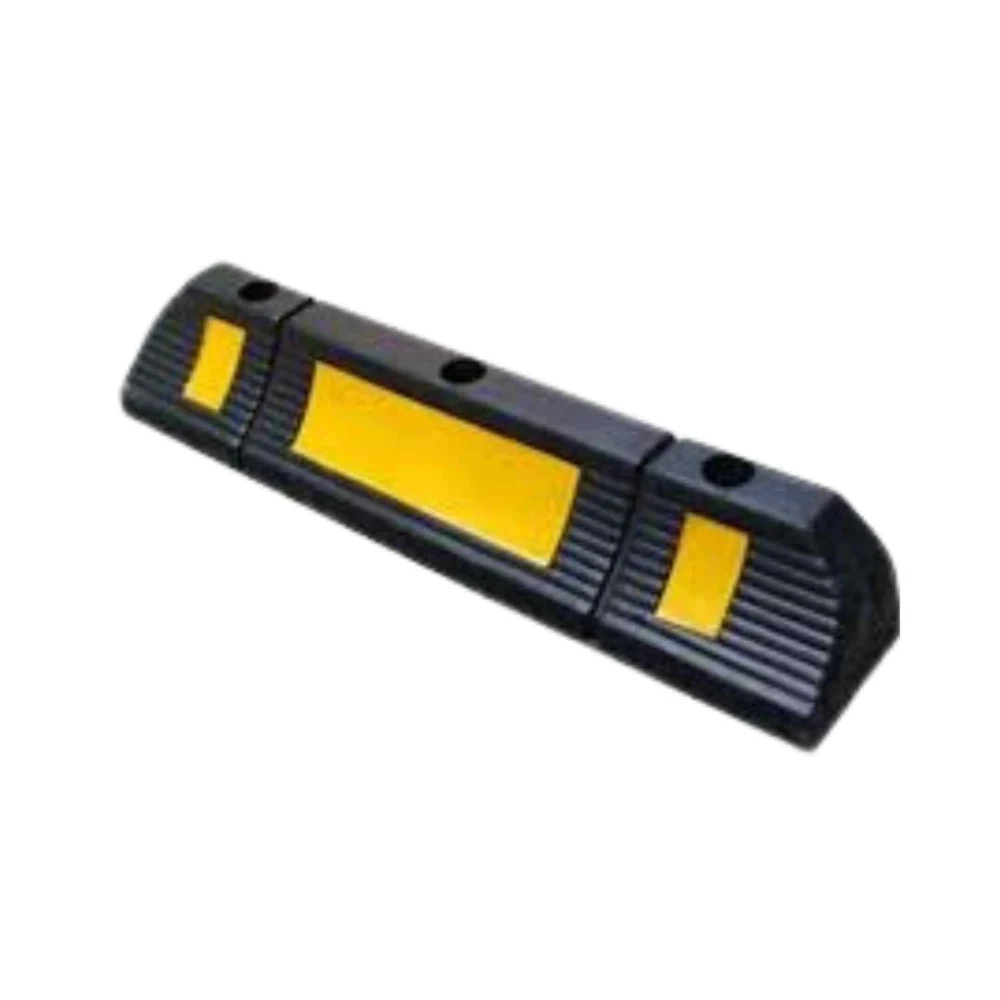
Road safety equipment for parking covers the items that slow vehicles down, guide them into bays and protect people, walls and pillars: speed breakers, wheel stoppers (parking blocks), barriers, traffic cones, convex mirrors, corner and pillar guards, road studs and delineators. Each one has a clear place in a parking layout, from the entry ramp to the last bay. This guide walks through a typical basement, open or factory parking area and explains where each item goes and what to look for.
Plan the parking area before you order
Take a printed layout or a phone photo of the plan and walk the area, ideally at a busy time. Mark on the plan:
- Entry and exit points, ramps and the boom barrier or gate
- Main driving aisles and the direction of travel
- Blind corners, ramp tops and turns where drivers cannot see oncoming cars
- Pillars, wall corners and pipes at bumper or door height
- Pedestrian routes: lift lobbies, staircases, walkways to the building
- Bays that back onto walls, glass, landscaping or footpaths
- Areas that need temporary closure for cleaning, events or repairs
With this marked plan, the quantities of each item become easy to count. Your building’s safety rules and local regulations set the minimum; check with your facility or safety officer, especially for public parking.
Speed breakers and rumble strips: control speed
Modular rubber or plastic speed breakers are bolted to the floor in sections, so the length matches the width of the drive aisle. Common places in a parking area are:
- Just inside the entry, after the gate or boom barrier
- At the bottom and top of ramps
- Before pedestrian crossings and lift lobby exits
- At long straight aisles where drivers tend to speed up
Lower-profile humps suit basements and slow-speed areas; taller ones are for open roads inside a campus. End caps finish the ends neatly, and yellow-black colouring keeps them visible in poor light. Rumble strips are a gentler option to warn drivers before a hump or a crossing. See the range of speed breakers. On concrete floors, anchor with the bolts and drilling depth the maker recommends; on asphalt, use the fixings meant for asphalt.
Wheel stoppers and parking blocks: stop at the right spot
A wheel stopper, also called a parking block or car stopper, sits at the back of each bay. The tyre touches it and the driver knows to stop, which protects the wall, glass, pipes or footpath behind the car. Place it so that the overhang of the car still clears the wall; makers usually suggest a distance, and you can adjust it for the larger vehicles in your fleet.
Rubber stoppers with reflective strips are common in basements; heavier ones suit trucks and loading bays. Fix each stopper with at least two anchors so it does not shift. Wheel chocks are a different item: they are placed against a tyre to stop a parked truck rolling at a loading dock. Both are under parking blocks and wheel stoppers, for example the Vertex rubber car stopper.
Road safety equipment for parking: where each item goes
Use this table as a quick reference when you mark up your plan.
| Item | Main job | Where it usually goes | How it is fixed |
|---|---|---|---|
| Speed breaker | Slow vehicles | Entry, ramps, before crossings, long aisles | Bolted to the floor |
| Rumble strip | Warn drivers | Before humps, crossings and gates | Bolted or fixed with adhesive |
| Wheel stopper | Stop the car at the bay end | Back of each bay, loading docks | Bolted, two or more anchors |
| Convex mirror | See around corners | Blind turns, ramp tops, exits onto roads | Wall or pole bracket |
| Corner and pillar guard | Protect cars and structure | Pillars, wall corners near turns | Screwed or bolted to the wall |
| Road stud | Mark lanes in low light | Lane edges, ramp edges, aisle centre lines | Fixed into or onto the floor |
| Delineator or spring post | Separate lanes | Entry/exit split, ramp lanes, walkway edges | Base bolted to the floor |
| Traffic cone | Temporary closure | Wet floors, repairs, reserved areas | Free standing |
| Barrier or barricade | Close or separate areas | Pedestrian routes, work zones, queues | Free standing or linked |
Visibility: convex mirrors, road studs and delineators
Convex mirrors
A convex mirror lets drivers see around a blind corner or the top of a ramp. Mount it high enough to clear vehicles and angle it so that drivers on both approaches can see each other. Larger mirrors suit wider aisles and longer viewing distances; a full dome mirror at a cross junction shows all four directions. Indoor and outdoor models differ in their housing. See convex mirrors.
Road studs
Reflective or solar road studs mark lane edges, ramp edges and the centre of a two-way aisle. They help in dim basements and on open campus roads at night. Space them evenly along the line; closer spacing on curves helps drivers follow the turn. The range is under road studs.
Delineators and spring posts
Spring posts are flexible posts that bend when hit and stand back up. They are used to split entry and exit lanes, keep cars off pedestrian walkways and guide traffic on ramps. A row of posts with reflective bands is easier to see than paint alone. See delineators.
Protecting walls, pillars and people
Pillars and wall corners in basements take regular scrapes from bumpers and doors. Rubber corner guards and pillar guards with yellow-black bands make the structure visible and soften minor impacts. Fit them at the height where bumpers and doors touch, on every pillar next to a driving aisle or a tight bay. Browse corner guards.
For people, keep walkways clearly separated from driving aisles. Barriers, chain and post sets and spring posts can mark the walkway, and water filled or plastic barricades can close off an area during works. Traffic cones are useful for short-term closures such as floor washing or a reserved area. See road safety barriers and traffic cones.
Installation and upkeep
- Clean and dry the floor before fixing humps, stoppers and studs.
- Use the anchors the maker supplies or recommends for your floor type.
- Check bolts every few months; loose sections of a speed breaker are a trip and tyre hazard.
- Replace reflective strips and damaged posts as they wear.
- Clean mirrors regularly; dust in basements reduces what drivers can see.
- Store cones and portable barriers where staff can reach them quickly.
Indicative prices and next step
Live starting prices for common items, shown as a guide before GST; the final price comes with the quote and depends on quantity and size:
- H2 rubber speed breaker: from ₹1,097.00
- Vertex rubber car stopper: from ₹227.00
- H2 convex mirror: from ₹983.00
- H2 rubber corner guard: from ₹144.00
- Kunplast road studs: from ₹665.00
- H2 spring post: from ₹227.00
All these items are in the road safety equipment section. Send your marked-up parking plan, or a list with aisle widths and the number of bays and pillars, on WhatsApp or by email, and we will work out quantities and share a quote with a GST invoice and Pan-India delivery.


